There may be songs on Spotify right now that sound like you, use your voice, and carry your name — that you never recorded. Anyone can now make an AI song with your voice in minutes, and AI voice clones of real artists have gone from novelty to epidemic: researchers flagged over 40,000 tracks in 2025 alone that were confirmed or strongly suspected to be AI-generated replicas of real performers. And it's not just embarrassing — it's expensive. In one widely reported 2026 case, a folk musician had her voice cloned by AI and then had her own recordings claimed by a copyright troll. The uncomfortable question every artist should be asking in 2026: is there a fake AI version of you out there — and is it quietly stealing your royalties?
The rise of the fake you
AI music generators can now clone a singer's voice and style from a handful of tracks. The result is a flood of deepfake songs uploaded under real artists' names, and the law is racing to catch up. Tennessee's ELVIS Act already bars using someone's voice in a "digital replica" without consent, and the proposed federal NO FAKES Act would create a licensable property right in every person's voice and likeness — enforceable against unauthorized AI voice clones. (Music Business Worldwide has documented how ugly this is getting.)
Protections are coming — but they only help artists who know a clone exists in the first place.
How an AI clone steals your money
A fake version of you isn't just a vanity problem. It hits your royalties in two very real ways:
- Fraudulent claims. Bad actors upload an AI-generated track using your voice or your song, then file a copyright claim on it. Platforms and collection societies can route the resulting royalties to the impostor — or freeze yours while it's disputed.
- False flags on the real you. As platforms purge tens of millions of AI tracks, detection is imperfect, and real recordings get swept up by mistake — flagged, demonetized, or removed. Your genuine song can lose its royalties simply because it was mistaken for a fake.
An AI clone doesn't have to fool your fans to cost you money — it only has to fool a copyright system that pays whoever claims a track first.
Either way, money that should be yours ends up unclaimed, diverted, or frozen — and you can't fight what you can't see.
AI cover songs: two different problems, two different fixes
Most fakes arrive as an AI cover song — your track, or your voice, regenerated by a model and uploaded somewhere. It looks like one problem. It's two, and confusing them is why artists chase the wrong remedy:
- They covered a song you wrote. This is a royalty question. In the US, anyone may cover a previously released song without asking you — that's the compulsory mechanical licence — but the songwriter mechanicals it generates are still yours, AI or not. The catch is collection: an AI cover uploaded with sloppy or missing songwriter credits produces royalties that sit unmatched instead of reaching you. (The same mechanics as any cover of your song.)
- They used your voice. This is an identity question, and no licence exists for it. A cloned voice engages your right of publicity — the ground the ELVIS Act and the proposed NO FAKES Act are built on — and Spotify's own rules treat a release that clones a real artist's voice without permission as removable, whether or not it's labelled "AI version".
So an AI cover song with your voice can owe you money and violate your likeness at the same time. The first you claim; the second you report.
Warning signs there's a fake you out there
You won't always get a notice. Watch for:
- A "new single" you never released, appearing under your name or a near-identical artist page.
- Uploads from an account you don't recognize using your voice, your style, or your song titles.
- Streams or payouts you can't explain — or a sudden claim that freezes your royalties.
- Robotic artifacts — phrasing, breath, or timing slightly off in a way a human singer wouldn't produce.
- A cover or remix that's a little too perfect, matching your voice with no collaborator credited.
If any of these turn up, the safest assumption in 2026 is that an AI-generated version of you is already out there — and the next step is to confirm it.
Human or AI? How deepfake music detection works
You don't have to guess. Audio-fingerprint detection runs every recording in your catalog against the signatures of the major AI generators and returns a plain Human-or-AI verdict, an AI-likelihood score (it flags at 50%), and even which model each track most resembles:
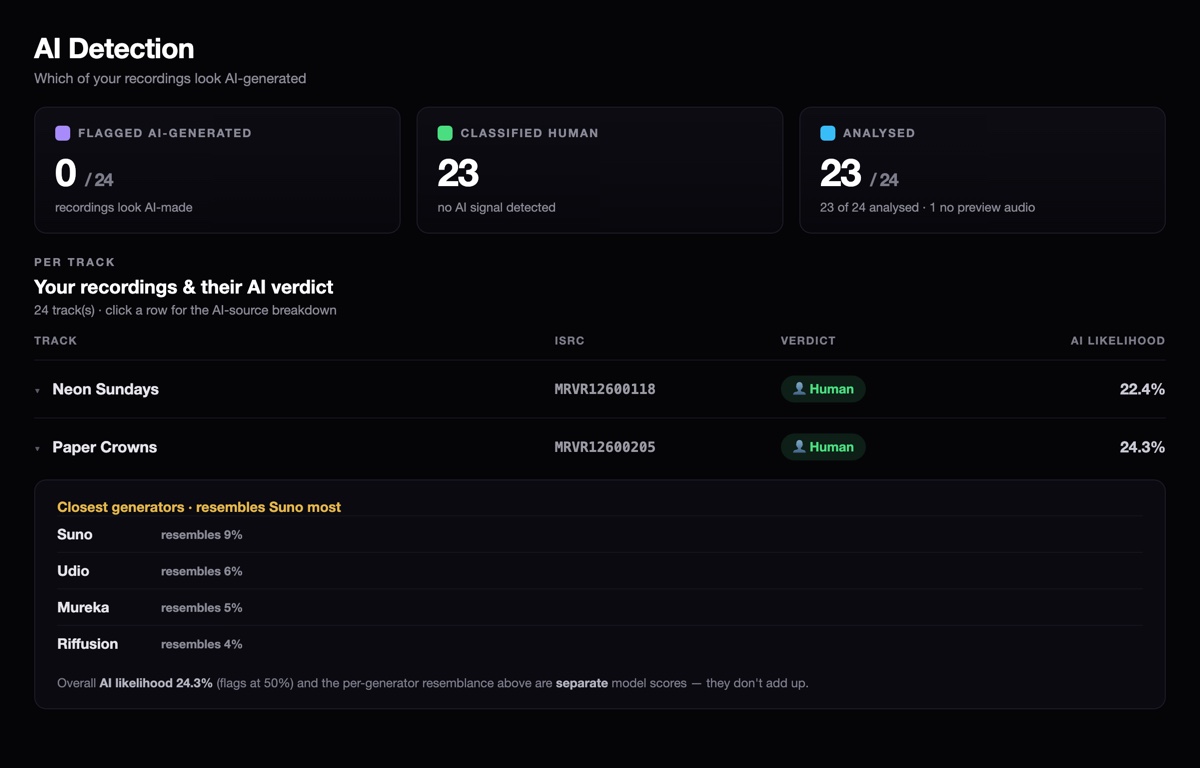
The point isn't to accuse anyone — it's evidence. A per-track verdict tells you, in writing, that your real recordings read as human — the documentation you need the day one of your tracks is wrongly flagged as AI and demonetized in the purge.
What SongBounty does about it
We can't police the whole internet for every impostor, and we won't pretend to. What we can do is give you the two things that actually help when AI is in play — plus keep finding the real money you're owed:
Verify your music is human
Every recording in your catalog gets a Human-or-AI verdict, an AI-likelihood score, and the AI generators it most resembles — documented proof your work is real, ready for any takedown or dispute.
Find AI covers of your songs
The same fingerprint surfaces other recordings of your songs — covers, remixes, and re-recordings — and flags which of those are AI-generated, so you can see AI versions of your work.
Protect the royalties you're owed
While you check for fakes, the same scan finds the real unclaimed royalties across your catalog, so nothing legitimate slips away. It's evidence, not a verdict from a court — and we never take a percentage. You keep 100% of anything you recover or protect. Run a free SongBounty scan to verify your catalog reads as human, surface any AI covers of your songs, and find the real unclaimed royalties you're owed in one pass, then see how it works. It's the recording-side companion to checking whether your music was used to train AI in the first place.
How to report an AI song on Spotify
Finding the fake is step one; getting it down is step two. Spotify's policy is explicit — a release that impersonates another artist's voice without permission comes down, whether or not it's presented as an "AI version" — but nothing happens until somebody files it:
Gather the evidence first. The track link, your matching real release, and a per-track verdict showing your own recordings read as human. A report with documentation attached moves; a report that just says "this isn't me" stalls.
File it as an artist, not a listener. Submit a claim through Spotify's legal form and choose Publicity / Likeness as the report type — that's the route built for a cloned voice. The generic listener path (Safety & Privacy Center → deceptive content) is weaker and has no AI option of its own.
Report it to the distributor too. The upload reached Spotify through someone's distributor, and that account is usually the faster kill switch — it can pull the release everywhere at once instead of platform by platform.
Turn on Artist Profile Protection. Spotify's opt-in control lets you review eligible releases before they land on your profile, which stops the next fake rather than chasing it.
Check the AI Persona badge. Since September 2026, Spotify labels profiles whose identity appears AI-generated and drops them from its recommendations — useful evidence when the impostor is a whole fake artist page, not just one track. One caution worth keeping: the badge and the purge both cut the other way. Detection is imperfect, so real artists get swept up too — which is exactly why documenting that your own catalog reads as human is worth doing before you ever need it.
How to protect yourself from AI cloning
Verify and check first. Run a scan to confirm your real tracks read as human and surface any AI covers of your songs — you can't dispute what you can't see.
Document that your real tracks are human. Keep the per-track verdicts and your original files as proof for takedowns and claim disputes.
Register and use your likeness protections. Lean on the ELVIS Act, the NO FAKES Act framework, and each platform's impersonation-report tools.
Keep your metadata and registrations clean. Correct ISRCs and songwriter IDs make it far easier to prove a track is — or isn't — really yours, and to reclaim any diverted royalties.
FAQ
Quite possibly. Tens of thousands of AI voice clone tracks of real artists have appeared on streaming platforms. The only way to know for sure is to check your name and catalog for AI-generated recordings you didn't make.
Yes — indirectly. Someone can upload an AI-generated track using your voice or song and claim the royalties, or your real song can be wrongly flagged as the fake and demonetized. Either way, money that should be yours ends up diverted or unclaimed.
Audio-fingerprint detection compares a recording to your real catalog and to known AI generators, returning a Human-or-AI verdict, an AI-likelihood score (it flags at 50%), and which model it most resembles. It's evidence, not proof — but it tells you where to look.
Find the fakes, document that your real tracks are human, use likeness protections like the ELVIS Act and NO FAKES Act, and keep your metadata and registrations clean so you can prove ownership and reclaim diverted royalties.
File it as an artist through Spotify's legal form and pick Publicity / Likeness, since a cloned voice is a likeness claim rather than a generic content complaint. Report it to the uploader's distributor as well — that account can pull the release from every platform at once — and attach evidence: the offending link, your real release, and a verdict showing your own recordings read as human.
Split the question. Covering a song you wrote is legal in the US without your permission under the compulsory mechanical licence — but the songwriter royalties it earns are still yours, AI or not, and they go unclaimed when the upload carries bad credits. Cloning your voice is the part with no licence behind it: that's a right-of-publicity issue under laws like the ELVIS Act, and platforms will remove it.
It depends on whose voice and where. Cloning a real, identifiable artist's voice without consent is already barred by Tennessee's ELVIS Act, is the target of the proposed federal NO FAKES Act, and breaks Spotify's impersonation policy regardless of what the law says in your state. Cloning your own voice, or a licensed model voice, is fine — consent is the dividing line.
No. We verify your recordings read as human, surface AI covers of your songs, and find your unclaimed royalties — and we never take a percentage. You keep 100% of what you recover.