Covers are having a moment. TikTok edits, sped-up remixes, acoustic versions, and full-on re-recordings are everywhere in 2026 — and every one of them is quietly generating money. Here's what most songwriters don't realize: when someone covers a song you wrote, the songwriter royalties on their version are owed to you — even a version you've never heard. It's some of the most commonly unclaimed royalties in music, for a simple reason: you can't collect on a cover you don't know exists. This is how cover song royalties work, and how to find out what you're owed.
Why a cover pays *you*, not the person who covered it
Every song is really two things: the composition (the song as written — melody and lyrics) and the recording (one specific recorded version). When someone covers your song, they create a new recording — and they own that master. But the composition is still yours. So the money splits:
- The cover artist keeps the recording royalties for their specific version.
- You, the songwriter, are owed the composition royalties on every version — the mechanical royalties (they need a mechanical license just to release the cover) and the performance royalties whenever it's streamed, played, or performed.
In other words, a hit cover can pay the original songwriter for years — but only if that songwriter is registered and actually claims it.
The covers you don't even know about
This is where the money leaks. Streaming platforms, YouTube, and TikTok are full of covers, remixes, sped-up edits, live re-recordings, and foreign-language versions — and most songwriters have no idea how many versions of their songs are out there.
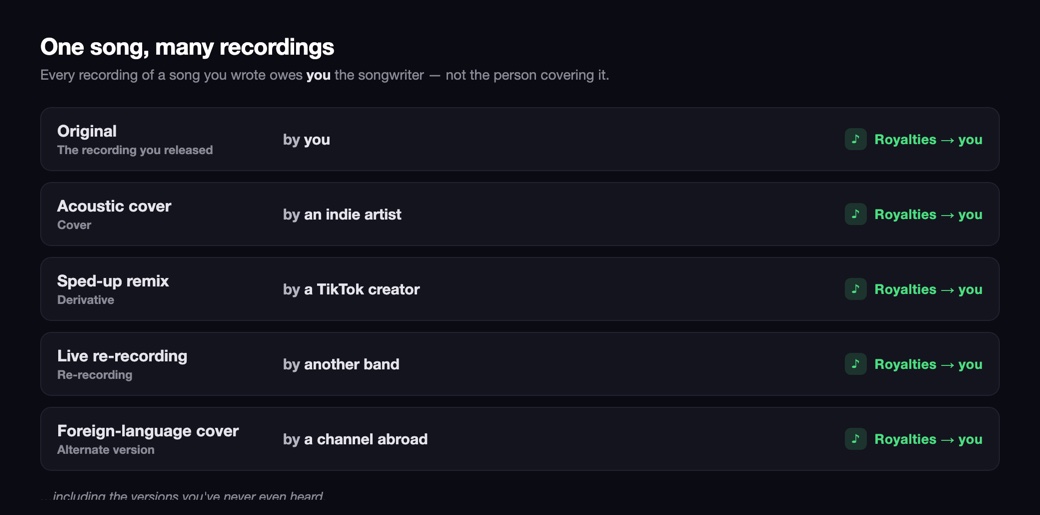
You can't claim royalties from a cover you don't know exists — and that's exactly the gap most songwriters never close.
A cover that blows up on TikTok might rack up millions of streams while the original writer never sees a statement for it. The royalties don't vanish; they sit unclaimed until someone connects that recording back to your composition.
How SongBounty finds every version of your song
This is a job for a music royalty finder. A free SongBounty scan fingerprints your recordings and surfaces every other recording of the same song — covers, remixes, re-recordings, and alternate versions — with the covering artist and title, so you can finally see who else recorded your work. Pair that with the rest of your missing royalties — mechanical, performance, radio, and international — and you get one picture of everything your catalog is owed, priced in dollars.
We don't collect for you, and we never take a percentage: you keep 100% of everything you recover. We just make the covers visible so you can claim them.
How to collect your cover song royalties
Once you can see the versions, collecting them comes down to registration:
Register the composition. Make sure the song is registered with the MLC and your PRO — that's what routes any version's royalties to you as the writer.
Confirm your splits. If you co-wrote, the split sheet decides who gets what; a wrong or missing split misroutes the money before it ever reaches you.
Claim the derivatives. For each cover or remix you've now surfaced, claim the held mechanical and performance royalties tied to your composition. Close those gaps and every future cover pays you automatically — including the same money hiding across your own catalog. Ready to see who's been covering you? Run a free scan and see how it works.
FAQ
Yes — if you wrote the song. The person covering it owns their recording, but you own the composition, so the mechanical and performance royalties on their version are owed to you as the songwriter. They also need a mechanical license to release the cover, which routes money back to you.
Two different owners. The cover artist owns their recording (master), while the original songwriter still owns the composition. That's why cover song royalties on the writing side flow to the original writer, not the person covering it.
Most songwriters can't — there's no single list. A music royalty finder like SongBounty fingerprints your recordings and surfaces every other version (covers, remixes, re-recordings) with the artist and title, so you can see what's out there and claim the unclaimed royalties.
Yes. SongBounty's free scan surfaces the covers of your songs and your other missing royalties, priced in dollars, before you pay anything — and you keep 100% of whatever you recover.