Your music doesn't stop at the border — and increasingly, neither does your money. Recorded-music revenue is now growing fastest outside the United States, which means more of what your catalog earns is being generated in countries you may never have visited. Every one of those plays owes you international royalties — performance royalties collected not by your US PRO, but by each country's own collection society: PRS in the UK, GEMA in Germany, SACEM in France, JASRAC in Japan, and dozens more.
Here's the problem almost no independent artist hears until it's too late: those societies can only pay you if your works are registered so they can be matched to you. Most artists never register internationally, so their international royalties pile up unclaimed — sometimes for years, in societies they've never heard of, in currencies they've never held. This is a market-by-market guide to that money: where it comes from, who's holding it, and how to find out what you're owed with a free scan.
The world map of your money
The center of gravity in music is shifting, and fast. Per IFPI's Global Music Report 2026, 2025 recorded-music revenue grew fastest in exactly the markets most indie artists ignore:
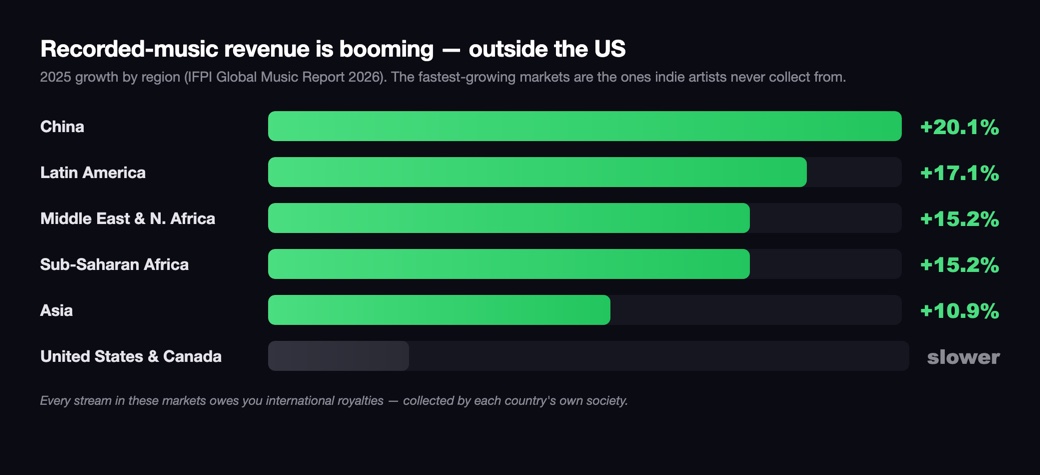
The global music royalty market is now worth roughly $40 billion and climbing. If your songs are streamed, aired on radio, or performed anywhere in Latin America, Africa, Asia, or Europe, money is being generated in your name right now — and it's growing every year. The only question is whether anyone is registered to collect it for you.
The three pots — why your foreign money never arrives
To understand international royalties, it helps to see that your performance income lives in three separate pots, each collected by a different body:
US mechanical royalties — The MLC
Your "copy money" from US streams, collected by The MLC. Domestic only — it does nothing for your plays abroad.
US performance royalties — ASCAP · BMI · SESAC · GMR
Your US "play money," collected by your PRO. Again, domestic — your US PRO does not automatically collect the money your songs earn in other countries.
International royalties — foreign societies
The performance royalties your music earns outside the US, each collected by that country's own society. This is the pot almost everyone forgets — and the one this guide is about.
Who collects your royalties, market by market
Your US PRO does not sweep up the money your music earns in France, Brazil, or Japan.
Reciprocal agreements between societies recover some foreign performance royalties — but the gap they leave, a registration gap multiplied across every market you're heard in, is one of the largest sources of unclaimed royalties in music.
There are dozens of collection societies worldwide — coordinated globally through CISAC — and each owns its own territory. Here are some of the biggest markets and the society that holds your money in each:
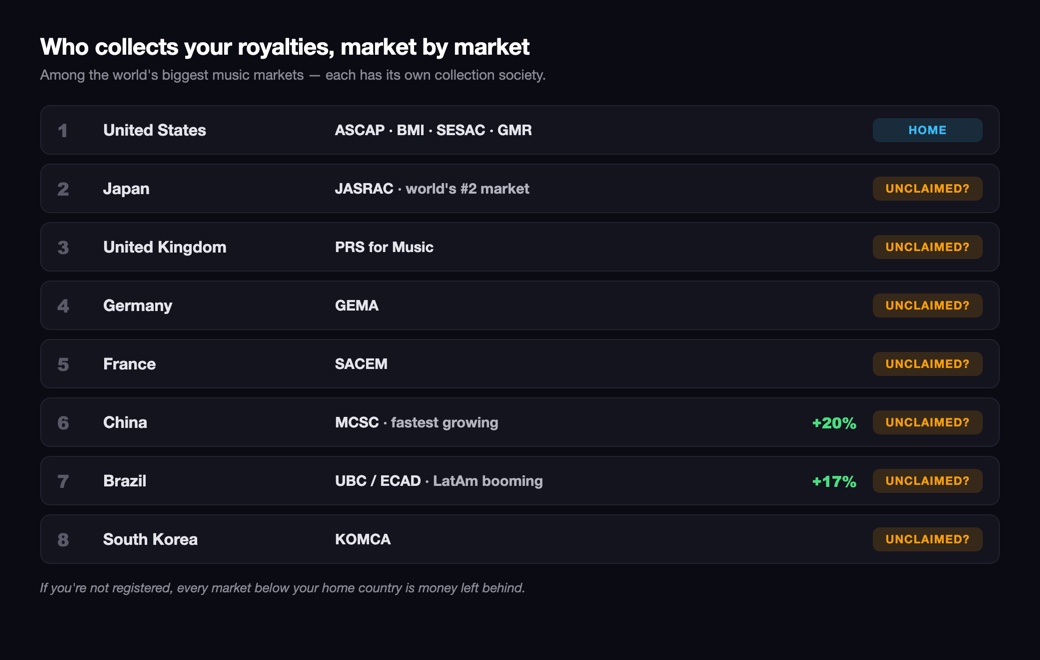
A quick tour of where your uncollected royalties are most likely hiding:
- Japan (JASRAC). The world's second-largest music market. If your songs get any play in Japan, JASRAC is collecting for them — and holding your share until you're matched.
- United Kingdom (PRS for Music). One of the most valuable and best-organized markets for global catalogs, and a common place for unclaimed English-language performance royalties to sit.
- Germany (GEMA) and France (SACEM). Two of Europe's largest markets, both with strong streaming and radio economies — and both full of missing royalties for unregistered writers.
- China (MCSC). The fastest-growing major market on earth (+20% in 2025). Barely on most indie artists' radar, and paying almost none of them.
- Brazil (UBC / ECAD) and the rest of Latin America (+17%). The single fastest-growing region, streaming enormous volumes of music whose writers rarely see a cent from it.
- South Korea (KOMCA), plus SGAE (Spain), SIAE (Italy), APRA (Australia), SADAIC (Argentina), and many more — every one a society holding claimable royalties for artists who never registered.
The markets you're probably ignoring — and shouldn't
Notice the pattern: the fastest-growing markets are the ones independent artists are least set up to collect from. A song that catches on in São Paulo, Lagos, Jakarta, or Seoul can rack up huge numbers while its writer never sees an international statement — because the money is sitting with a society in a country the artist never thought to register in.
This is the flip side of going viral globally. Cross-border streaming makes your music travel; it does not make your royalties find you. Someone still has to connect each play back to your registered works — and if no one does, that money eventually gets redistributed to others through each society's own "black box."
How SongBounty finds what the world owes you
You can't register everywhere blindly — you need to know where your music is actually earning. That's exactly what a music royalty finder does. A free SongBounty scan runs the kind of royalty audit a global publisher would run before buying a catalog: it sizes your international royalties from where your songs really stream, maps each market to its collection society, and flags the countries where you're earning but not registered — surfacing the unclaimed, uncollected, and unidentified money as a ranked list of claimable royalties, priced in dollars, as an estimate (read it as "at least this much").
It even keeps monitoring your royalties, rescanning as your music spreads into new markets, so new missing royalties don't slip past you. And international money is only one pot — the same scan finds the rest of your unclaimed royalties at home: mechanical royalties (The MLC), US performance royalties (your PRO), and your radio / neighboring rights — across both publishing and sound recordings.
We don't collect for you, and we never take a percentage — you keep 100% of everything you recover, and every new market you break into just means you collect more of the royalties you're already owed.
How to collect your international royalties
Once you can see where your money is stuck, collecting it comes down to registration:
Affiliate with your home PRO and register your works. This is the foundation — your compositions have to exist in the system before any foreign society can match a play to you.
Prioritize your biggest markets. Use your scan to see where you actually earn abroad, and go after those societies first — that's where the largest unclaimed royalties are.
Complete your registrations territory by territory,. making sure your metadata (titles, songwriter IDs, splits) is correct so foreign societies can match you cleanly.
Use a sub-publisher or international admin for scale. If you're earning across many countries, an admin can register and collect across societies on your behalf so you don't have to chase each one.
FAQ
You're owed for them — but only if you're set up to collect. Performance royalties earned abroad are collected by each country's own society (PRS, GEMA, SACEM, JASRAC, and more), and reach you only if your works are registered so those societies can match them to you.
They're the performance royalties your music earns outside your home country — from streaming, radio, and public performance abroad — collected by foreign societies rather than your US PRO. For most independent artists they go uncollected.
Every major market has one: PRS (UK), GEMA (Germany), SACEM (France), JASRAC (Japan), MCSC (China), KOMCA (South Korea), SGAE (Spain), SIAE (Italy), APRA (Australia), UBC/ECAD (Brazil), SADAIC (Argentina), and dozens more.
Only partly. Reciprocal agreements between societies recover some foreign performance royalties, but there's a real leak — especially if you never registered your works internationally. That gap is one of the most common sources of missing royalties.
Find out where your music is actually streaming, then register with (or use an admin to reach) the societies in those markets. A music royalty finder like SongBounty sizes your international unclaimed royalties by market with a free scan and shows you exactly where to register — and you keep 100% of what you recover.
No. We find what you're owed worldwide and show you how to claim it — you register and file — and we never take a percentage. You keep 100% of everything you recover.